Design and Fabrication of Portable ECO-friendly Water Filtration Equipment for Remote Villages Using Solar and Wind Energy
Procedure
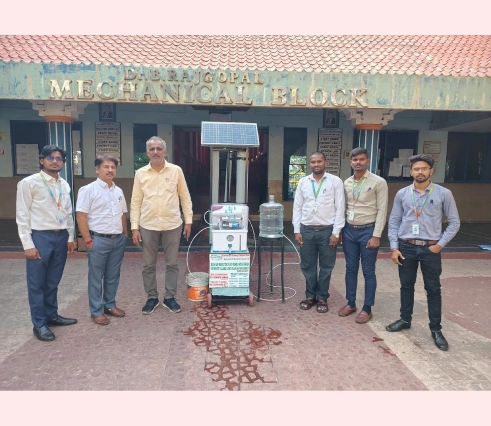
The project involves designing a multi-stage water purification system incorporating processes like sedimentation, activated carbon filtration, and advanced purification methods integrated with solar panels and a small wind turbine along with energy storage. The fabrication process emphasizes the use of eco-friendly and durable materials to ensure reliability and ease of use in rural conditions. This system is expected to provide safe drinking water without dependence on conventional power sources, thereby reducing environmental impact and promoting sustainable development. The proposed solution has wide applications in remote villages, disaster relief operations, and off-grid locations, ultimately contributing to improved public health, energy efficiency, and environmental conservation.
Member assign in project
Mr. S Aftab
Mr. J Lakshmi Narayana
Mr. Siddhartha K
Mr. K Shivananda
Project Head
Dr V Venkata Ramana
Performance Analysis of 3D Printed Horizontal Axis Windmill Designed by NACA Curves Operating by Variable Wind Speed
Procedure
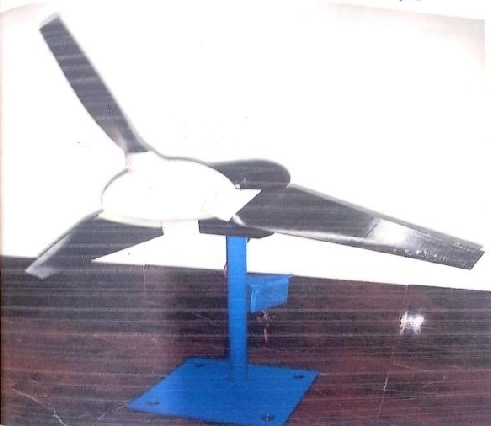
This project focuses on the design, fabrication, and evaluation of a small-scale wind energy system using advanced manufacturing techniques. With the increasing need for renewable energy sources, wind energy has become a key area of research and development. In this project, a horizontal axis wind turbine (HAWT) is designed using airfoil profiles based on NACA curves to achieve improved aerodynamic performance. The turbine blades are fabricated using 3D printing technology, allowing precise control over blade geometry, reduced manufacturing cost, and rapid prototyping.
Member assign in project
Ashoka A
Basavaraja A
Bheemesha K B
Manju K
Project Head
Kalyan Babu
Solar Parabolic Dish Concentrator for Water Boiling
Procedure
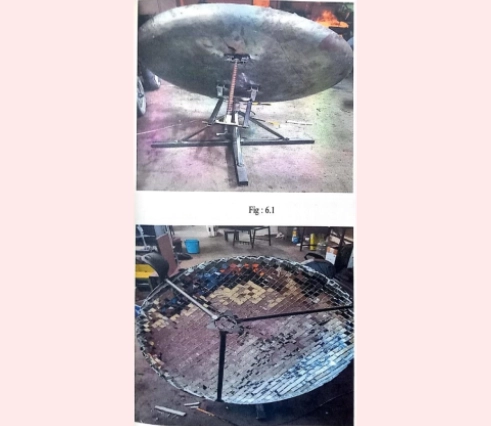
The main objective of this project is to design an efficient solar concentrator system and evaluate its performance in boiling water using solar energy. The methodology involves designing the parabolic geometry, fabricating the dish structure, assembling the system with proper alignment, and testing it under sunlight conditions. Temperature variations are recorded over time to analyze thermal efficiency and performance. The system is simple in construction, cost-effective, and requires minimal maintenance.
Member assign in project
Abdul Rasheed P
Project Head
Dr. Shekar K
Waste paper pen and pencil manufacturing machine
Procedure
This project is ecofriendly, waste material was used to manufacture the pen and pencils with minimum cost and unskilled labor can operate it.
Member assign in project
Ms. Afra Anjum
Mr. Nagesh M
Mr. Bharath SP
Mr. B Shrikanth
Project Head
Prof. Shivakumar S Y
Development of Automobile brake lining using pulverized cow hooves
Procedure
Because of its unique physical and chemical characteristics, asbestos has been employed as brake lining in cars for a long time. Its use has decreased although the use of many other materials is expanding since handling it poses a health risk. In this experiment, an asbestos-free brake lining was made using crushed cow hooves, epoxy glue, barium sulphate, graphite, and aluminium oxide.
Member assign in project
Mr. Prasad E
Mr. Abhishek Kumar K
Ms. Usha
Mr. ChandraShekar
Project Head
Prof. Vijay Kumar B P
Generating electricity by Roof top turbo exhaust ventilator
Procedure
In most of the ware houses turbo exhaust has been implemented which circulates fresh air by rotation this rotational speed can by utilized for power generation
Member assign in project
Mr. Thota Abhishek
Mr. M Pavan
Mr. Venkatesh N
Mr. Y Manoj Kumar
Project Head
Prof. Maharaja Gouda
Fabrication of hybrid Tri E – vehicle
Procedure
This E-Vehicle is used for transferring goods especially in super markets
Member assign in project
Mr. J Chandra
Mr. Jayanth DM
Mr. K Srikantha
Mr. Shashi Kumara G
Project Head
Prof. Taranath A
Smart Helmet
Procedure
It's an Innovative idea that a smart helmet has multi functions, vehicle won't start without wearing an helmet and if a person is detected by an alcohol also it sends an information to the registered mobile if any accidents occurs
Member assign in project
Md Saleem
Md Shahama
Md Sohail Raza
Md Yousuf B
Project Head
Prof. Gavi Siddappa P
Waste plastic to plastic bricks
Procedure
This Idea has been initiated to utilize the scrap plastic and manufacture the bricks which have greater in strength and less dense compared to clay type bricks