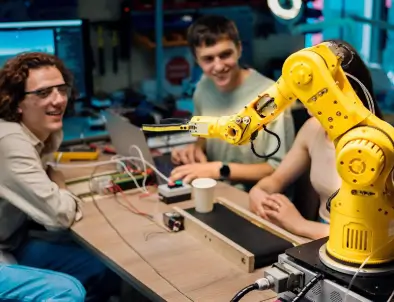
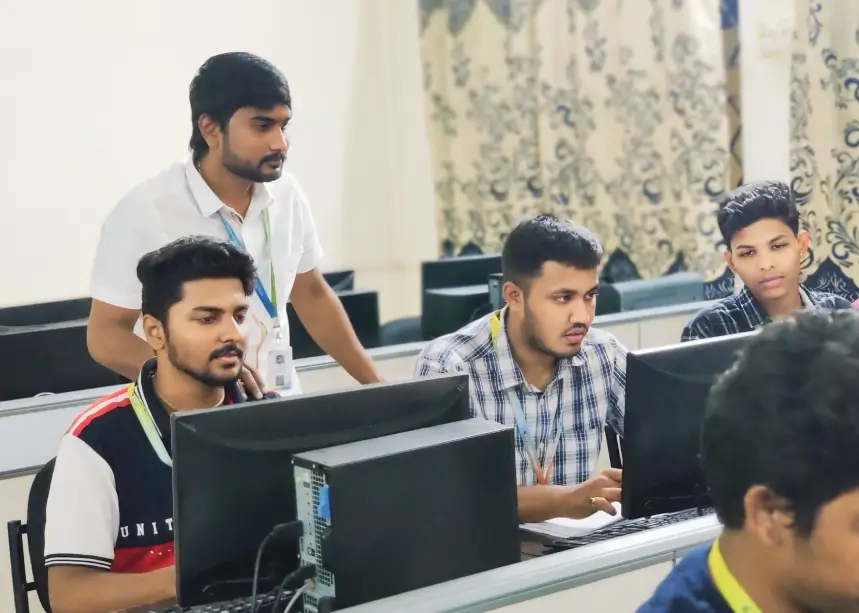
AI graduates have diverse career options across industries, from building and deploying machine learning models as Machine Learning Engineers to analyzing data patterns as Data Scientists. They can work as Research Scientists, pushing the boundaries of AI innovation, or specialize in fields like Computer Vision and Natural Language Processing to develop image and language-based solutions. Roles like AI Product Manager and AI Consultant combine technical and strategic skills to implement AI-driven products effectively.
Opportunities also exist in niche fields, such as AI Ethics, Financial Services, Healthcare, and AIOps, allowing AI professionals to shape responsible, innovative applications. With AI's rapid growth, these careers offer promising pathways with significant impact potential.
The Bachelor of Engineering (B.E.) course in CSE(Artificial Engineering) is a 4-year professional undergraduate program. The Computer Science & Engineering (Artificial Intelligence) program is designed to equip students with the knowledge and skills to develop intelligent systems capable of mimicking human cognitive functions. Gain a strong understanding of core computer science concepts like algorithms, data structures, programming languages, software engineering, and computer architecture. The program focuses on practical applications of AI and ML.
Eligibility Criteria
Students who have passed Karnataka 2nd PUC/ 12th Std, / 10+2 / Intermediate or equivalent exam with Physics & Mathematics along with Chemistry/ Computer Science / Biology and any other optional subject with English as one of the languages of study and should have obtained a minimum of 45% marks. For SC/ST & other backward classes of Karnataka students only, the minimum marks is 40% in aggregate in the optional subjects in the qualifying examination, irrespective of marks obtained in the Common Entrance Test / COMED-K/ AIEEE.
A degree in Computer Science & Engineering (Artificial intelligence)
Machine Learning Engineer
Data Scientist
AI Research Scientist
AI Product Manager
Organizations and clubs
Computer Vision Engineer
Natural Language Processing (NLP) Engineer
Robotics Engineer
Business Intelligence Developer
AI Ethics Specialist
Quantitative Analyst
AI Consultant
Full-Stack Developer with AI Expertise
Teaching/Academia
Entrepreneur
Program Fees
Duration
4 Years
Program
CSE-Artificial Intelligence (AI)
Type
SNQ
CET
COMED-K
MANAGEMENT
Amount
Rs. 46,360/-
Rs. 1,22,495/-
Rs. 3,070,87/-
Rs. 2,65,000/-
Admission Process
Students who have passed Karnataka 2nd PUC / 12th std / 10+2 / Intermediate or equivalent exam with Physics & Mathematics along with Chemistry / Computer Science / Biology and any other optional subject with English as one of the languages of study and should have obtained a minimum of 45% marks.
For SC/ST & Other backward classes of Karnataka students only, the minimum marks is 40% in aggregate in the optional subjects in the qualifying examination, irrespective of marks obtained in the Common Entrance Test / COMED-K / AIEEE / any other equivalent entrance examinations. (Eligibility as per the Govt. Norms from time to time).
Programme Educational Objectives (PEOs)
PEO-1
Accomplish a progressive career by applying fundamental principles and design methodologies of computer science and engineering.
PEO-2
Provide practical solutions to solve problems of industry and society at large.
PEO-3
Exhibit professionalism through managerial skills and develop innovative products.
Program outcomes (POs)
PO 1
Engineering Knowledge
Apply knowledge of mathematics, natural science, computing, engineering fundamentals and an engineering specialization as specified in WK1 to WK4 respectively to develop to the solution of complex engineering problems.
PO 2
Problem Analysis
Identify, formulate, review research literature and analyze complex engineering problems reaching substantiated conclusions with consideration for sustainable development. (WK1 to WK4)
PO 3
Design/Development of Solutions
Design creative solutions for complex engineering problems and design/develop systems/components/processes to meet identified needs with consideration for the public health and safety, whole-life cost, net zero carbon, culture, society and environment as required. (WK5)
PO 4
Conduct Investigations of Complex Problems
Conduct investigations of complex engineering problems using research-based knowledge including design of experiments, modelling, analysis & interpretation of data to provide valid conclusions. (WK8).
PO 5
Engineering Tool Usage
Create, select and apply appropriate techniques, resources and modern engineering & IT tools, including prediction and modelling recognizing their limitations to solve complex engineering problems. (WK2 and WK6)
PO 6
The Engineer and The World
Analyze and evaluate societal and environmental aspects while solving complex engineering problems for its impact on sustainability with reference to economy, health, safety, legal framework, culture and environment. (WK1, WK5, and WK7).
PO 7
Ethics
Apply ethical principles and commit to professional ethics, human values, diversity and inclusion; adhere to national & international laws. (WK9)
PO 8
Individual and Collaborative Team work
Function effectively as an individual, and as a member or leader in diverse/multi-disciplinary teams.
PO 9
Communication
Communicate effectively and inclusively within the engineering community and society at large, such as being able to comprehend and write effective reports and design documentation, make effective presentations considering cultural, language, and learning differences
PO 10
Project Management and Finance
Apply knowledge and understanding of engineering management principles and economic decision-making and apply these to one’s own work, as a member and leader in a team, and to manage projects and in multidisciplinary environments.
PO 11
Life-Long Learning
Recognize the need for, and have the preparation and ability for i) independent and life-long learning ii) adaptability to new and emerging technologies and iii) critical thinking in the broadest context of technological change. (WK8)
Programme Specific Outcomes
PSO 1
Demonstrate the principles, architecture and organization of computers, embedded systems and computer networks.
PSO 2
To develop software applications using advanced technologies to cater the growing needs of industry.
Program Curriculum 2022 Scheme
Sl No
Course code
Course Name
1
22MATS11
Mathematics for CSE Stream-I
2
22PHYS12
Physics for CSE stream
3
22POP13
Principles of Programming Using C
4
22ESC14x
Engineering Science Course-I
5
22ETC15x
Emerging Technology Course-I
Or
22PLC15x
Programming Languages Course-I
6
22ENG16
Communicative English
7
22KSK17 22KBK17
Samskrutika Kannada/Balake Kannada
Or
20ICO17
Indian Constitution
8
22IDT18
Innovation and Design Thinking
Or
22SFH18
Scientific Foundations of Health
Sl No
Course code
Course Name
1
22MATS21
Mathematics for CSE Stream-II
2
22PHYS22
Physics for CSE Stream
3
22POP23
Principles of Programming Using C
4
22ESC24x
Engineering Science Course-II
5
22ETC25x
Programming Language Course-II
Or
22PLC25x
Emerging Technology Course-II
6
22PWS26
Professional Writing Skills in English
7
22KSK27 22KBK27
Samskrutika Kannada/Balake Kannada
Or
20ICO27
Indian Constitution
8
22IDT28
Innovation and Design Thinking
Or
22SFH28
Scientific Foundations of Health
Sl No
Course code
Course Name
1
22MDA31
Graph theory and Discreet Mathematical Structures
2
22CA32
Digital System Design and Computer Organization
3
22CA33
Operating System
4
22CS34
Data Structures and Applications
5
22CAL35
Data Structures Lab
6
22CA36
ESC/ETC/PLC
Object Oriented Programming With JAVA
7
22SC37
Social Connect and Responsibility
8
22CA38X
Ability Enhancement Course /
Skill Enhancement Course - III
9
22NS39
National Service Scheme (NSS)
10
22PE39
Physical Education (PE) (Sports and Athletics)
11
22YO39
Yoga
Sl No
Course code
Course Name
1
22BB41
Biology for Engineers
2
22CA42
Principles of Artificial Intelligence
3
22CA43
Database Management Systems
4
22CA44
Analysis and Design of Algorithms
5
22CAL45
Algorithms Lab
6
22CA46X
ESC/ETC/PLC
7
22PSW47
Professional Skills for the Work Place
8
22UH48
Universal human values course
9
22NS49
National Service Scheme (NSS)
10
22PE49
Physical Education (PE) (Sports and Athletics)
11
22YO49
Yoga
Sl No
Course code
Course Name
1
22CA51
Software Engineering & Project Management
2
22CA52
Computer Networks
3
22CA53
Machine Learning
4
22CAL54
Machine Learning Lab
5
22CA55X
Professional Elective Course
6
22XXMN56
Mini Project
7
22ADA57
Ability Enhancement Course / Skill Development Course
After the announcement of the reopening date of the college, the candidates have to register for admission with an application enclosing all the photos copies of previous semester marks card/s through their department HOD and they have to pay the applicable Tuition Fees / Registration Fees within a week of reopening the institute for class work.
The students who fail to register within the first week of re-opening, the student will be charged a penalty
The names of the students will be deleted, in case they fail to register as per the schedule
Any financial matters are required to be referred to the principal only
Once the student is admitted he/she will be under the guidance of the department and all the academic matters should be addressed through the Head of the department only.
Students are expected to maintain discipline in the college campus & not to indulge in “Ragging Activities”.
FAQs
CSE-AI is a dynamic and rapidly evolving field with several compelling reasons for its prominence:
Innovation and Advancements: CSE-AI drives innovation by developing intelligent systems capable of learning from data and making decisions. This leads to advancements in various industries and their applications.
Problem Solving: CSE-AI provides tools to tackle complex problems that traditional algorithms might struggle to address. This includes image and speech recognition, natural language processing, and autonomous systems.
Interdisciplinary Applications: CSE-AI intersects with various disciplines, fostering collaborations and interdisciplinary research. It finds applications in fields such as robotics, neuroscience, and bioinformatics.
Emerging Technologies: As emerging technologies like the Internet of Things (IoT) and augmented reality become more prevalent, CSE-AI plays a crucial role in developing intelligent systems that can harness the potential of these technologies.
Demand in Industry: There is a growing demand for professionals with expertise in CSE-AI across industries. Companies are leveraging these technologies to gain a competitive edge and improve their operations.