A diversity of people and ideas. coupled with free and open discourse, lays the foundation
18.Aug.2025
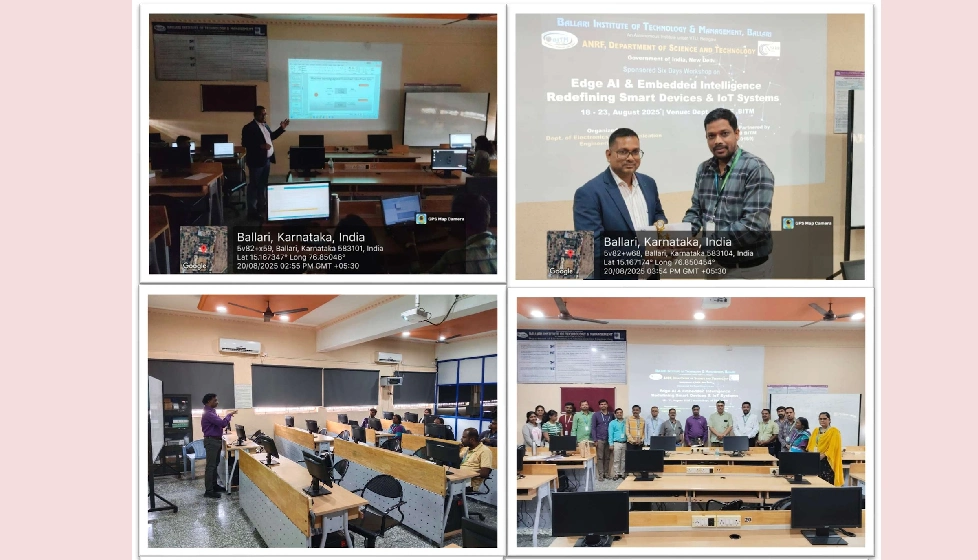
Workshop on “Edge AI & Embedded intelligence Redefining Smart Devices & IOT systems”
Date: August 18, 2025(day 1) Speaker: Dr. Mohammed Farukh Hashmi. Session Duration: 4 hours 40 minutes Dr. Mohammed Farukh Hashmi introduced the fundamentals of Artificial Intelligence and Machine Learning in an accessible manner. He explained key concepts such as multimodal fusion, the MNIST dataset, and Support Vector Machines (SVM). The session also covered the practical applications of ML across various sectors including healthcare, finance, and robotics. Dr. Hashmi emphasized the importance of hands-on practice and comparative analysis to deepen understanding. He concluded with an overview of neural networks, their structure, and historical development, highlighting their resurgence due to advancements in GPUs and big data.
Date: August 19, 2025( day 2) Speaker: Prabhudeva V H. Session Duration: 3 hours 40 minutes Prabhudeva V H delivered a comprehensive overview of the Internet of Things (IoT), its architecture, and market potential. He discussed the four-stage IoT model—sensors, gateways, edge IT, and cloud—and highlighted the role of foundational layers like connectivity and data management. The session also explored the growing significance of edge computing in reducing latency and enhancing real-time decision-making. Practical use cases such as smart parking and predictive maintenance were presented, along with strategic insights into TCS’s end-to-end IoT solutions.
Date: August 20, 2025 (day 3) Speaker: Subhra Prakash Giri. Session Duration: 5 hours Subhra Prakash Giri focused on Edge AI and Embedded Machine Learning, contrasting traditional programming with ML approaches. He explained the end-to-end ML pipeline and discussed the advantages of Edge AI, including reduced latency, improved privacy, and energy efficiency. Participants learned how to select appropriate hardware for Edge AI applications and were introduced to MLOps. The session included a live demonstration of a gesture-control system using TinyML, followed by a discussion on diverse applications such as wildlife monitoring and industrial anomaly detection.
Date: August 21, 2025 (day 4) Speaker: Mettu Srinivas Session Duration: 5 hours Mettu Srinivas used a creative analogy of an alien classifying fruits to explain supervised learning and feature engineering. He then delved into the architecture of Convolutional Neural Networks (CNNs), detailing the roles of convolutional, pooling, fully connected, and dropout layers. The session also covered groundbreaking CNN architectures like AlexNet, VGGNet, and ResNet, emphasizing innovations such as ReLU activation, dual GPU training, and residual connections that enabled deeper and more accurate models
Date: August 22, 2025 (day 5) Speaker: Sunil C K Session Duration: 4 hours 30 minutes Sunil C K provided an in-depth technical exploration of Convolutional Neural Networks, including hyperparameter tuning, parameter sharing, and the mechanics of forward and backward propagation. He extended the discussion to Multitask Learning (MTL), explaining both hard and soft parameter sharing techniques. The session highlighted how MTL improves generalization, data efficiency, and computational performance, while also addressing challenges such as task interference and complex optimization
Date: August 22, 2025 (day 6) Speaker: Dr. P. Mahalakshmi Session Duration: 4 hours 10 minutes Dr. P. Mahalakshmi presented specialized session on the convergence of AI and Digital Signal Processing in audiology. She explained how AI is transforming hearing devices from static amplifiers to adaptive, cognitive systems. The talk covered real-time environmental classification, deep noise suppression, binaural processing, and personalized learning through reinforcement. Dr. Mahalakshmi also discussed AI-powered diagnostics and closed-loop neuromodulation for conditions like tinnitus, while addressing ethical an
Related Events
03.Nov.2023
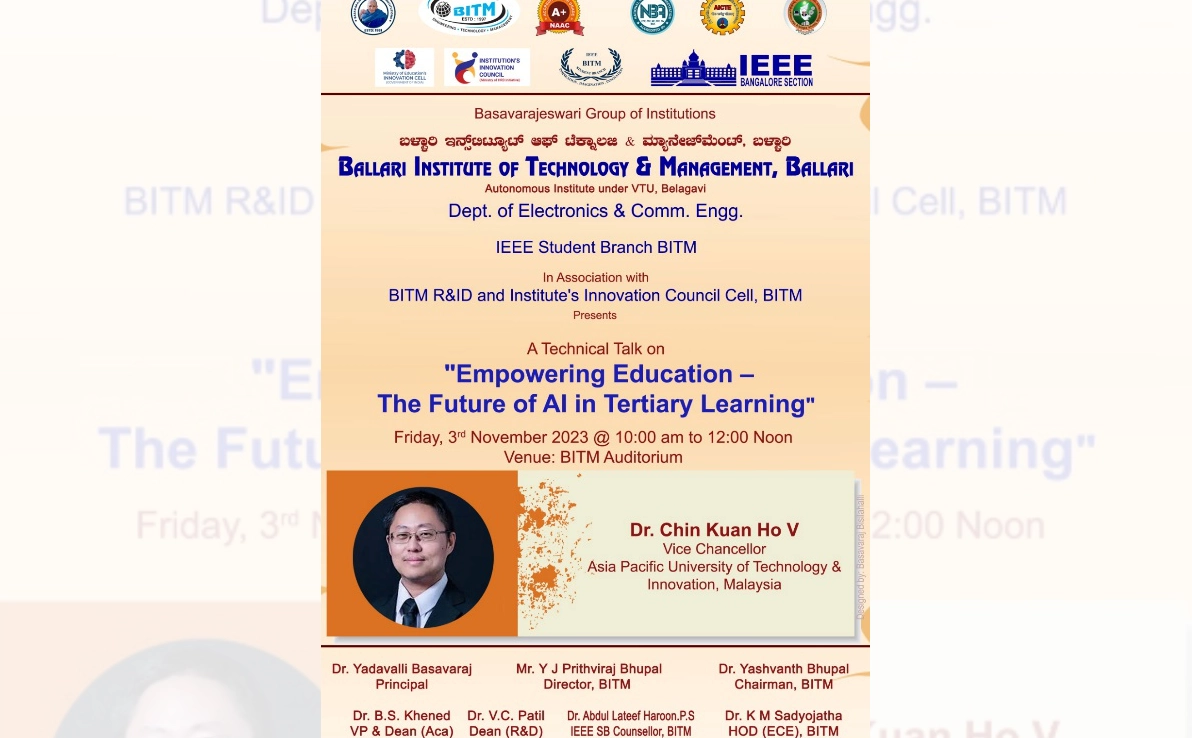
Empowering Education-The Future of AI in Tertiary Learning