A diversity of people and ideas. coupled with free and open discourse, lays the foundation
06.Nov.2025
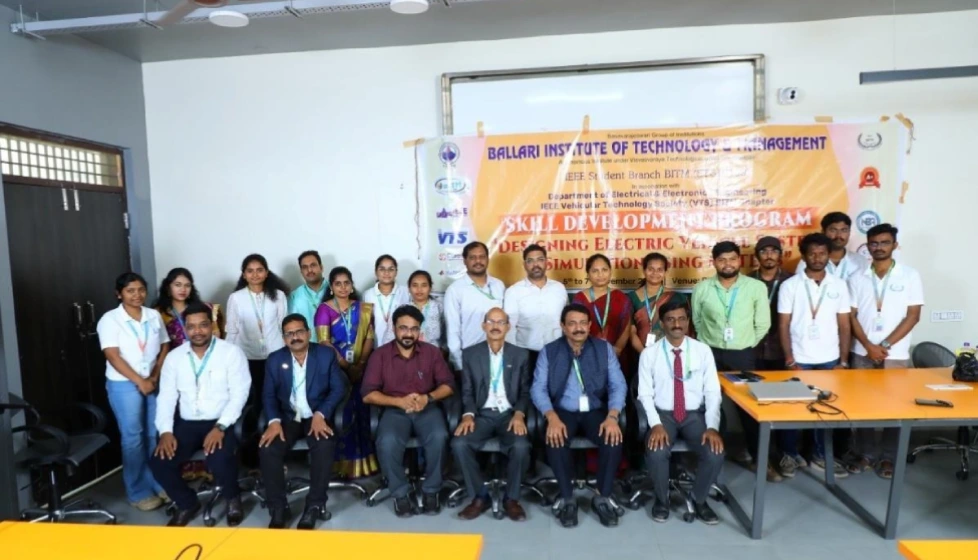
Hands-on Workshop on Ev Design and Simulation with MATLAB
A two-day workshop on Electric Vehicle (EV) Design Using MATLAB and Simulink was organized to provide participants with a comprehensive understanding of model-based design, simulation, and analysis of electric vehicle systems. The sessions were conducted by Dr. Riyaz Rahiman and Dr. Debanand Singdeo, renowned experts in electrical and electronic system design. The workshop offered a perfect blend of theoretical concepts and hands-on simulation exercises, enabling participants to gain valuable insights into real-world engineering applications.
Day 1: Model-Based Design Using MATLAB and Simulink Date:6th November, 2025
The first day focused on introducing participants to Model-Based Design (MBD) principles and familiarizing with simulation techniques using MATLAB and Simulink. The morning session, handled by Dr. Riyaz Rahiman, began with an introduction to Model-Based Design and its growing importance in modern engineering. He explained how MBD streamlines the product development process by integrating design, testing, and implementation within a unified environment. Participants learned how MBD helps reduce development time, enhance accuracy, and improve performance reliability. Dr. Riyaz also introduced various System Modeling Paradigms—including continuous, discrete, and hybrid systems—and demonstrated how these paradigms can be represented and analyzed using MATLAB and Simulink. Live simulations illustrated how different system models behave under varying input and environmental conditions, helping participants visualize theoretical concepts in action.
The afternoon session, led by Dr. Debanand Singdeo, focused on Modeling Dynamic Systems and Physical System Modeling using Simscape. He explained how mathematical equations describing system dynamics can be converted into visual block models in Simulink. Participants were guided through building and simulating dynamic system models while studying the influence of different parameters on overall system performance.
The session further explored Simscape, a MATLAB add-on for modeling physical systems such as electrical, mechanical, and thermal components. Dr. Debanand demonstrated how to construct a complete physical system model and analyze its performance through simulation, highlighting the industrial relevance of model- based design in engineering problem-solving.
Throughout the day, both resource persons engaged with participants, clarifying doubts and ensuring practical understanding. The interactive teaching approach encouraged experimentation with simulation parameters and hands-on learning. The day concluded with a Q&A session, where participants discussed applications of MBD in electric vehicle development and other engineering domains.
Session started at: 10:30.a.m, Session ended at: 4:00.p.m
Day 2: Electric Vehicle Design Using MATLAB Date: 7th November, 2025
The second day extended the learning experience into the design and simulation of Electric Vehicle systems. The sessions, once again led by Dr. Debanand Singdeo and Dr. Riyaz Rahiman, focused on the key aspects of EV system architecture, motor control, and simulation-based design validation. The day’s topics included EV Architectures, Motor Modeling, DC Motor Speed Control, Power Electronics for EV, Vehicle Body Design, and EV Reference Applications, followed by an interactive Q&A session.
The morning session, handled by Dr. Debanand Singdeo, began with an overview of EV architectures and the fundamentals of motor modeling. He explained the interconnection between various EV subsystems such as the powertrain, motor, and control units. Through MATLAB and Simulink demonstrations, he showed how motor models can be developed and simulated under various operating conditions. His detailed and structured explanation helped participants relate theoretical concepts to practical implementation.
In the afternoon session, Dr. Riyaz Rahiman covered advanced topics including DC motor speed control, power electronic converters, and vehicle body design principles. He illustrated how MATLAB and Simulink can be used to analyze and optimize motor performance, control strategies, and system efficiency. His presentation on EV reference applications provided real-world case studies, giving participants insight into how MATLAB-based modeling is used in industry for EV design, testing, and optimization.
Both resource persons maintained high interaction throughout the sessions, ensuring every participant gained clarity and confidence in using MATLAB and Simulink for EV system analysis. The well-structured content, coupled with practical demonstrations, made the sessions highly engaging and informative. The concluding Q&A session allowed participants to discuss implementation challenges, share observations, and receive expert feedback.
Session started at: 9:30.a.m, Session ended at: 3:30 p.m.
Conclusion
The two-day workshop on Electric Vehicle Design Using MATLAB and Simulink proved to be an enriching and insightful experience. It successfully bridged the gap between theoretical learning and practical application, equipping participants with essential skills in model-based system design, simulation, and analysis. The dedication and expertise of Dr. Riyaz A Rahiman and Dr. Debanand Singdeo played a vital role in making the sessions interactive, informative, and impactful. Overall, the workshop significantly enhanced students’ technical competence and provided a strong foundation for future projects and research in the field of electric vehicle design and simulation.