A diversity of people and ideas. coupled with free and open discourse, lays the foundation
08.Oct.2026
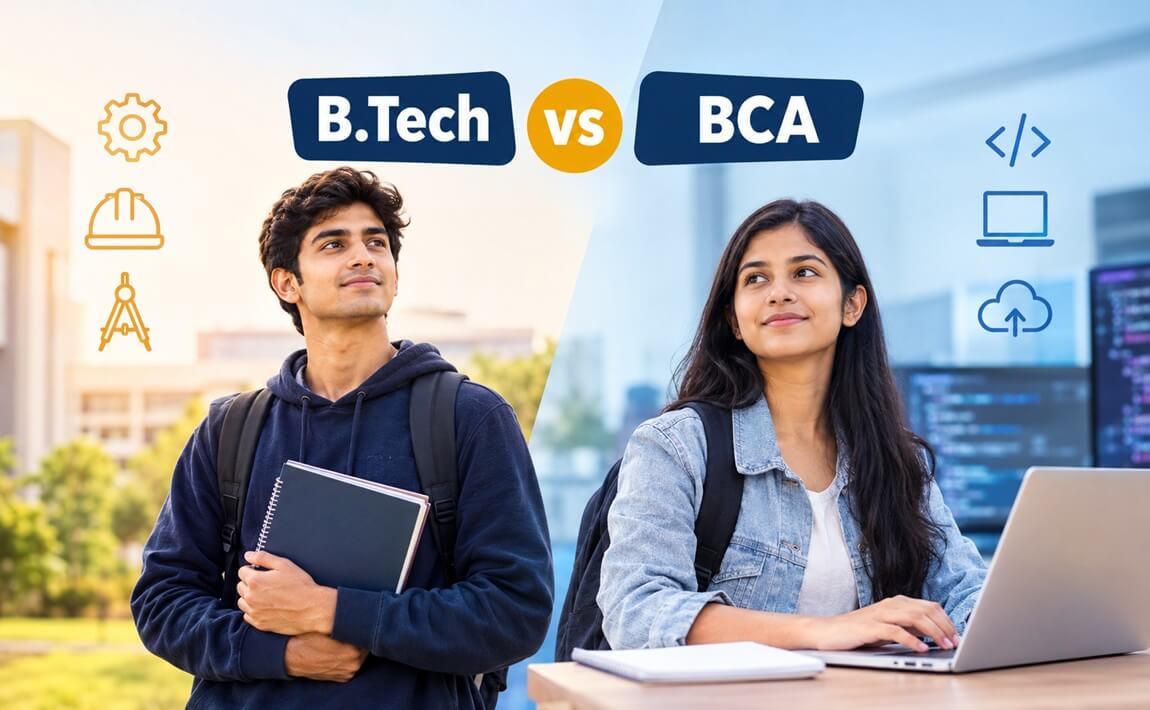
B.Tech vs BCA After 12th – Which Is Better?
Choosing a career in technology after Class 12 might be challenging as two popular options – B.Tech and BCA – seem to lead to comparable jobs. Both can lead to the IT sector, but they take very distinct academic routes. B.Tech has an engineering-centered curriculum. BCA, meanwhile, is more narrowly focused on computer applications, programming, and software development. This distinction is important when comparing B. Tech vs BCA after 12th, as the appropriate choice depends a lot on what a student wishes to pursue next.
So, the question of B. Tech vs BCA which is better can be best answered by looking at job goals, learning preferences, practical exposure, and future study plans.
B. Tech vs BCA: Understanding the Fundamental Difference
Factor
B.Tech
BCA
Programme type
Engineering degree
Computer applications degree
Typical duration
4 years
Usually 3 years
Academic focus
Engineering + technology
Computer applications + software
Learning approach
Theory, engineering concepts, labs and projects
Programming, applications and software concepts
Suitable for
Students seeking deeper technical/engineering education
Students focused on computer applications and software
B. Tech vs BCA After 12th: Eligibility and Admission Considerations
Students also need to review the entrance requirements before making a choice between the two. Most of the standard engineering programs for B. Tech require Class 12 with Physics, Chemistry and Mathematics however the specific prerequisites depend on the college and the field you choose.
Admission may be through a national, state, or institute-level entry process. Usually, the eligibility for BCA is wider after Class 12, although some colleges may have a requirement of Mathematics or Computer Science.
So, it is good to check these details early when comparing B. Tech vs BCA after 12th. The admission regulations can differ, and the latest criteria on the official website of the chosen college should always be the ultimate reference.
How Are B. Tech and BCA Different? A Curriculum Comparison
Area
B.Tech
BCA
Programming
Strong emphasis in relevant branches
Core component
Mathematics
Generally stronger
Programme-dependent
Engineering concepts
Significant
Limited
Computer science
Can be highly specialised
Application-focused
Laboratory work
Extensive technical/engineering labs
Computer/application labs
Projects
Engineering and industry-oriented
Software/application-oriented
Emerging technologies
AI, ML, Data Science, cloud, cybersecurity, etc., depending on branch
Programming, databases, web, applications, and emerging tech depending on curriculum
Career Opportunities after B. Tech or BCA
Both B. Tech and BCA can get you a job in the technology field; however, the path can be different. As a B.Tech graduate, you can study fields including software development, data science, artificial intelligence, cloud technology, and systems based on your branch and interests.
Other than this, BCA graduates can also enter professions in software development, web design, testing, application support, and other IT roles. But it is not the degree that counts. Employers also value:
Practical skills
Projects
Internships, and
The capacity to address real-world challenges.
Hence, students should choose the course that offers the kind of foundation they want to build upon later.
Career Pathways at a Glance
B.Tech Graduate
BCA Graduate
Software Engineer
Software Developer
Data/AI roles
Web Developer
Systems/Technology roles
Application Developer
Cloud/Infrastructure roles
Software Support roles
Embedded/technical roles, depending on branch
Database-related roles
Product/technology roles
QA/Testing roles
Technical consulting
IT/Technical support
What Does Current Industry Data Say?
The career alternatives after the completion of graduation generally depend on how much technical knowledge a student gains during the course. B.Tech can lead to positions like software engineering, data and AI, cloud infrastructure, systems technology, and technical consultancy. The particular path is typically decided by the branch of engineering.
BCA graduates can also join the software industry in the areas of software development, web design, application development, testing, database management and technical assistance.
The overlap is rather evident, although the nature of the task may shift as students gain experience. Internships, projects, and practical skills can make a big difference when students start seeking employment.
Industry Skills Students Should Build
Skill Area
Why It Matters
Programming
Foundation for software and technology careers
AI/ML
Growing relevance across technology sectors
Data skills
Supports data-driven decision-making
Cloud
Important for modern digital infrastructure
Cybersecurity
Increasing importance of digital security
Communication
Helps with teamwork and professional growth
Problem-solving
Core requirement across technical roles
B.Tech vs BCA: Which One Should You Choose?
Choose B.Tech if:
You want a deeper engineering/technical foundation.
You are interested in AI & ML, data science, computer science or engineering technologies.
You want a four-year engineering degree.
You prefer extensive technical labs and engineering projects.
You may consider technical postgraduate education later.
Choose BCA if:
You specifically want computer applications/software.
You prefer a shorter undergraduate pathway.
You want to build programming and application-development skills.
You may plan to pursue MCA afterwards.
You want flexibility to develop skills through certifications, projects, and internships.






 22.Jun.2026